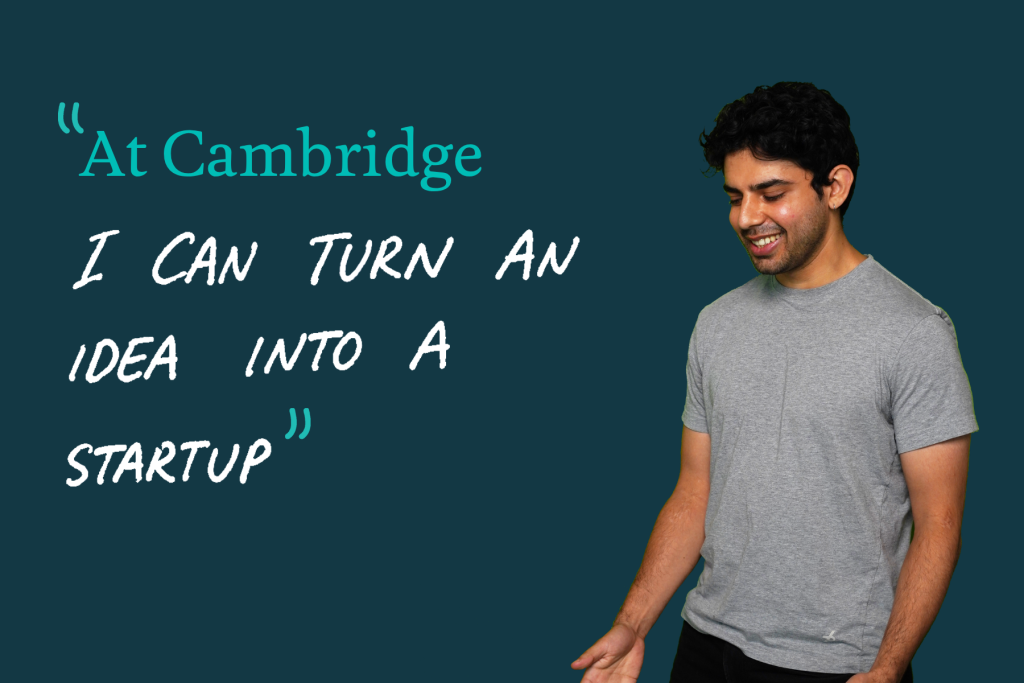
“At Cambridge I can turn an idea into a startup.”

Callon Peate
Callon is a PhD student at Clare College and co-founder of GreenMixes, which develops carbon-negative cement additives that cut cement use. He is based in Cambridge’s Institute for Manufacturing.

When Callon Peate arrived in Cambridge for his PhD at the Institute for Manufacturing, he knew he wanted his work to be meaningful. He also saw an industry ripe for change.
Construction has a significant carbon footprint and Callon saw an opportunity to rethink one of its most widely used materials: cement. Drawing on his background in chemistry and materials science, he began exploring whether new additives could reduce the amount of cement needed while also locking away carbon.
As Callon began exploring how new materials could help tackle this challenge, he started to see the potential for a business too. He had always been interested in starting a company, and Cambridge gave him the chance to test whether his idea could work.
Through competitions, programmes and conversations with mentors and other founders, he and his co-founder developed the idea further. It became GreenMixes, which is developing carbon-negative cement additives that reduce cement use and create carbon sinks.
Out of the comfort zone
Callon believes entrepreneurship is not about having a perfect idea from the start – quite the opposite.
Your initial idea is going to be rubbish. You can only improve it by putting yourself outside of your comfort zone.
Taking GreenMixes forward meant doing many of the things that researchers can find uncomfortable: pitching, networking, seeking feedback and risking rejection.
The first few months were challenging and many of the venture’s early applications were unsuccessful. Rather than viewing those setbacks as failures, Callon saw them as opportunities to improve.
Support to learn quickly
Over time, that willingness to learn paid off. GreenMixes went on to win the Postdoc Venture Creation Challenge, the Trinity Bradfield Prize and the Cambridge Climate Challenge. Through the competitions, the team gained access to experienced mentors who challenged their thinking, refined their value proposition and helped them better understand what customers actually needed. What looked like success from the outside was built on months of feedback, iteration and support from people across Cambridge’s entrepreneurial ecosystem.
I think you learn more from failure than you do from succeeding.
Proving it was possible
When the idea was in its early stages, some people doubted it could work. For Callon, a defining moment was seeing the experimental results come together and being able to demonstrate that the concept really was possible.
It reinforced something he had been learning throughout the process: progress rarely comes from getting everything right first time; instead, it comes from improving step by step.
Today, what continues to motivate him is the opportunity to build something impactful while constantly learning along the way. His advice to anyone considering entrepreneurship is not to wait until they feel fully ready.
Sometimes the biggest step is not having the perfect idea. It is being willing to leave your comfort zone and see where it leads.
Start, learn, improve and keep going.
How Cambridge helped
i-Teams brings together the brightest students and ground-breaking university research to develop commercially viable strategies and build university-industry links, in Cambridge and beyond.
Impulse is a unique entrepreneurship programme created specifically for early-stage tech and life science innovators as they embark on the journey from scientific insight to validated commercial proposition.
The Postdoc Venture Creation Challenge (PVCC) is aimed at supporting busy University of Cambridge postdocs interested in taking their first steps into creating a venture from their research. More than a competition the PVCC provides workshops, mentoring and an incredible launchpad for early-stage ideas.
The Trinity Bradfield Prize aims to encourage and assist young scientists, engineers and entrepreneurs at the University of Cambridge to start companies capable of translating their ideas, inventions and discoveries into products.
The Cambridge Climate Challenge is an annual competition delivered by Cambridge Zero, in partnership with Carbon13, Cambridge Enterprise, the Maxwell Centre, Energy IRC, King’s Entrepreneurship Lab and CISL Canopy. Designed to inspire innovation across disciplines, it invites students, researchers and emerging entrepreneurs to develop bold approaches to reducing emissions, building resilience and driving sustainable change.
Co-Labs by Journey provides flexible, fully fitted laboratory and office space for early‑stage science and technology companies in Cambridge. Co‑Labs is particularly suited to collaboration‑driven businesses, with a programme of events and networking opportunities that connect founders with investors, advisors and innovation partners across Cambridge.
Find out where IE Cambridge can take you
Learn moreMore stories
-
Dushanth Seevaratnam
At Cambridge I can publish papers and launch a venture

Dushanth Seevaratnam
Dushanth is a postdoc and co-founder of GreenMixes, a startup that develops carbon-negative cement additives that cut cement use. He is at Cambridge’s Institute for Manufacturing and a Bye-Fellow at Churchill College.
-
Milena Flankova
At Cambridge I can bring my expertise into a new field

Milena Flankova
Milena is a PhD student at Pembroke researching epigenetics in chronic liver disease. She co-founded Nereus Health at Cambridge’s Early Cancer Institute, a rapid diagnostic tests startup, to assess fish population health and detect disease early.
-
Maheera Abdul Ghani
At Cambridge I can be a scientist and a founder

Maheera Abdul Ghani
Maheera is applying her research in ultra-thin semiconductors into a startup. She is co-founder and CEO of Dielectrix and a Forbes under 30. She is a postdoc in the Department of Material Science & Metallurgy and an alumna of Queens' College.
-
Hanniya Kamran
At Cambridge I can design buildings and design a business

Hanniya Kamran
Hanniya is the co-founder of Go Tiffin, a food-sharing startup connecting home cooks with local eaters and Canopy, a social venture linking faith-based charitable giving to climate action. She is an architecture postgrad at Murray Edwards College.
Get started and make your idea a reality with the help of IE Cambridge