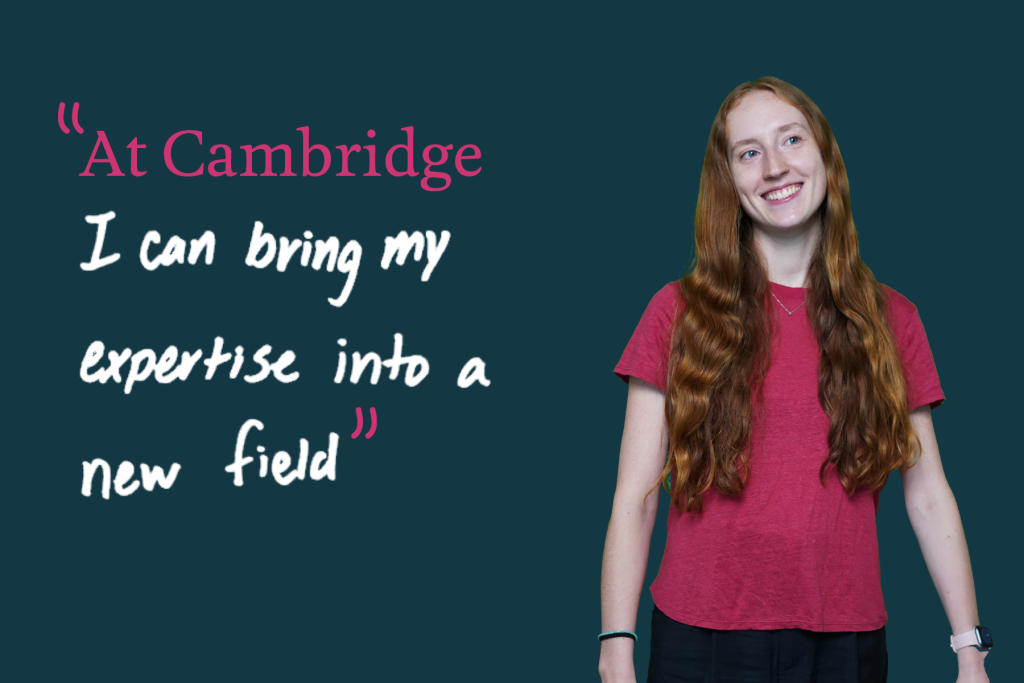
“At Cambridge I can bring my expertise into a new field.”

Milena Flankova
Milena is a PhD student at Pembroke researching epigenetics in chronic liver disease. She co-founded Nereus Health at Cambridge’s Early Cancer Institute, a rapid diagnostic tests startup, to assess fish population health and detect disease early.

When Milena Flankova arrived in Cambridge to research the epigenetics of chronic liver disease, she didn’t expect to find herself working on fish health.
Her focus was firmly on medical research. However, during the first year of her PhD, she began exploring opportunities beyond the laboratory, through university events, Building Bridges in Medical Sciences (BBMS) and programmes introducing researchers to entrepreneurship.
One of those programmes was Bio-spark. What began as a chance to learn how startups are developed soon opened the door to a different way of thinking about impact.
An unexpected partnership
Through Cambridge, Milena met fellow PhD student John McGinty.
The two researchers came from different backgrounds, but they shared a curiosity about applying science to real-world challenges. John had experience in veterinary diagnostics and had identified a potential opportunity in aquaculture, while Milena brought expertise in epigenetics research. Together, they began exploring a problem neither had expected to tackle when they first arrived in Cambridge.
“I’d never imagined before that I’d be working on aquaculture,” Milena says. “But when I got to Cambridge, I made these interesting connections.”
Those conversations eventually led to the creation of Nereus Health, which aims to close aquaculture’s billion-dollar diagnostic gap with rapid, on-farm fish health testing.
Looking beyond your own field
For Milena, one of Cambridge’s greatest strengths is the way it brings together people with different expertise.
The beauty about being in Cambridge is that you're exposed to different people with different expertise, as well as many resources such as programmes and events.
That environment encouraged her to think beyond the immediate application of her research. The scientific knowledge she developed through studying human disease suddenly became relevant in an industry she had never expected to work in.
Together, Milena and John began learning everything they could about fish farming, speaking to industry experts, conservationists and potential users. Every conversation revealed something new and helped shape the venture’s direction.
Connections that changed the journey
A major turning point came through the Parmee Prize at Pembroke. The competition helped Milena and John test their idea, gain feedback and build connections outside their immediate field. One introduction led to conversations with wild fish and conservation specialists, prompting the team to think differently about potential applications for their technology.
For Milena, it was further proof that you do not need to have everything figured out before you start.
Your idea doesn't need to be perfect. It doesn't need to be fully developed to start getting involved with the industry and making connections.
Looking back, Milena believes that is what Cambridge makes possible. A researcher studying liver disease can find herself helping to solve challenges in aquaculture. A chance conversation can become a co-founding partnership. Expertise developed in one field can unlock new ways of thinking in another.
Your expertise can have even greater impact when it meets somebody else’s. Sometimes the most valuable contributions emerge when different perspectives come together around a shared challenge.
How Cambridge helped
BBMS is a society that brings together people from different disciplines, career stages and countries. The society aims to provide opportunities to generate discussions across fields and chances for individuals to be exposed to different potential career trajectories. In addition to being a society, BBMS runs an annual conference that invites prominent speakers to Cambridge and is a platform for researchers to display their work on a larger scale.
The Emma Enterprise Lab and Competition gives participants hands‑on experience in developing and pitching a venture idea. Teams receive mentoring and guidance as they refine their ideas, build business models and prepare pitches, with shortlisted teams competing in a final and the opportunity to win prize funding.
Bio-spark is an educational entrepreneurship programme that provides support for early-stage scientists, including but not limited to those engaged in a PhD or Postdoc. It provides opportunities to sample different company environments and mentorship that may lead to the formation of companies.
The Parmee Prize is an annual entrepreneurship competition for Pembroke College students, designed to support aspiring founders at every stage of the entrepreneurial journey. Established by entrepreneur and Pembroke alumnus Dr Richard Parmee, the competition encourages students to develop innovative business ideas and gain practical experience in entrepreneurship.
Find out where IE Cambridge can take you
Learn moreMore stories
-
Osarenkhoe Ogbeide
At Cambridge I can connect research, community and venture-building

Osarenkhoe Ogbeide
Osarenkhoe is a Royal Society Fellow in engineering at Churchill College. He is developing graphene-based gas sensors that can detect hard-to-measure gases at much lower levels, enabling new safety-monitoring applications.
-
Dushanth Seevaratnam
At Cambridge I can publish papers and launch a venture

Dushanth Seevaratnam
Dushanth is a postdoc and co-founder of GreenMixes, a startup that develops carbon-negative cement additives that cut cement use. He is at Cambridge’s Institute for Manufacturing and a Bye-Fellow at Churchill College.
-
Callon Peate
At Cambridge I can turn an idea into a startup

Callon Peate
Callon is a PhD student at Clare College and co-founder of GreenMixes, which develops carbon-negative cement additives that cut cement use. He is based in Cambridge’s Institute for Manufacturing.
-
Sophia Rahman
At Cambridge I can shape the world, not just study it

Sophia Rahman
Sophia is the CEO and co-founder of Studia, which she developed as a Master’s student in Chinese at Lucy Cavendish College. Studia is a creator-led platform that helps educators scale their teaching and offers students affordable, personalised learning.
Get started and make your idea a reality with the help of IE Cambridge