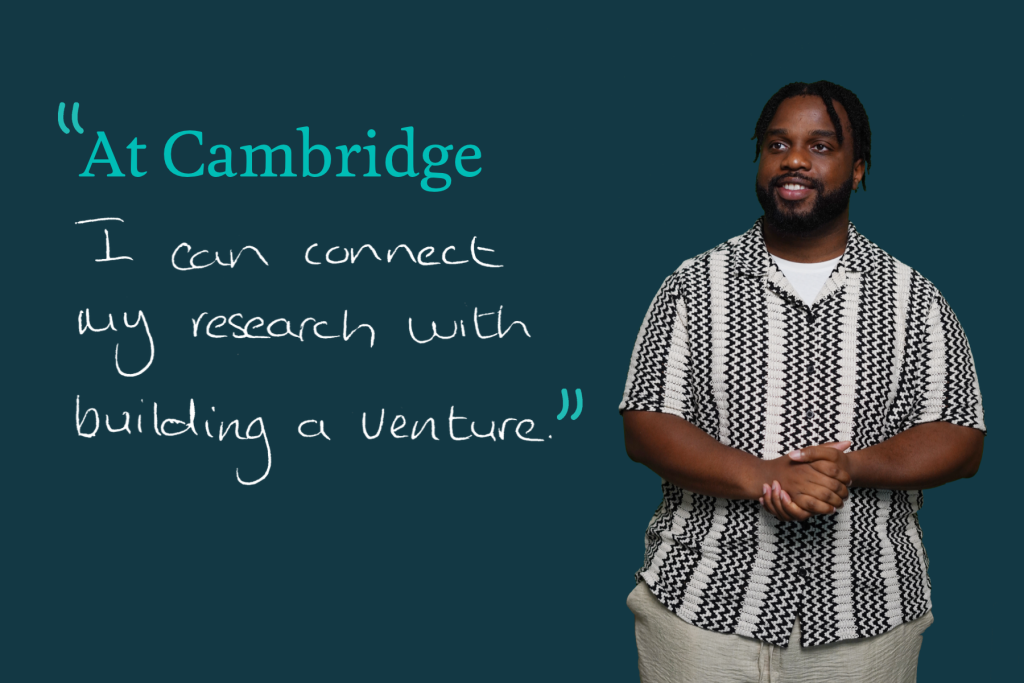
“At Cambridge I can connect research, community and venture-building.”

Osarenkhoe Ogbeide
Osarenkhoe is a Royal Society Fellow in engineering at Churchill College. He is developing graphene-based gas sensors that can detect hard-to-measure gases at much lower levels, enabling new safety-monitoring applications.

For Osarenkhoe Ogbeide, entrepreneurship isn’t a departure from research; it’s another way to create impact. As a Royal Society Career Development Fellow and an Early Career Research Fellow at Churchill College, he’s exploring how advanced gas-sensing technologies could move beyond the lab and into the hands of the people who need them most. His venture is Obasense, which is creating a new form of low cost, hyper-sensitive sensors using advanced nanomaterials for detecting toxic and dangerous gases and pollutants for multiple areas and industries.
When Osarenkhoe arrived at the University of Cambridge in 2018 to begin his PhD, his focus was on science. His research explores nanomaterials and graphene-based sensors that can detect gases at levels that are currently difficult or impossible to measure. As his work progressed, though, he began thinking about impact and value in a broader sense.
“I saw the applications of my research and the commercial viability of it,” he explains.
I was looking at how I could bring this research out of the lab and actually put it into the hands of people and businesses that might need it.
Today, alongside his academic career, he is exploring how these technologies could be developed into devices that improve safety and monitoring in environments where current solutions fall short.
His journey challenges the idea that researchers must choose between academia and entrepreneurship. For him, the two are complementary.
Finding community and confidence
A key turning point came when Osarenkhoe started engaging more actively with Cambridge’s entrepreneurial ecosystem.
He took part in programmes including EnterpriseTECH, Founders at the University of Cambridge SYNC, impulse and the Postdoc Venture Creation Challenge, gaining new skills, confidence and connections along the way. Through Founders SYNC, he also met his co-founder, Timothy Lambden.
Seeing other researchers and founders succeed was powerful:
Being in Cambridge and seeing so many different spinouts – successful spinouts – and entrepreneurs within this ecosystem lets you know that you can too.
That sense of supportive community has become one of the most valuable parts of his entrepreneurial journey. Cambridge offers access to expertise, programmes, mentors and like-minded people, all within an ecosystem designed to help ideas develop and grow.
A safe place to start
For researchers considering entrepreneurship, Osarenkhoe’s advice is simple: don’t wait for a ‘perfect’ moment.
As an early-career researcher, he believes Cambridge offers a unique opportunity to explore entrepreneurial ideas alongside an academic career. “I have my standard academic career going,” he explains.
While utilising my free time as best as I can, I can fit in these pockets where I can try out my ideas in a very safe way.
Through conversations with other founders and support from programmes across the University, he learned that entrepreneurship is not about having all the answers on day one – it’s about taking the first step and learning as you go.
That mindset has also changed the way he thinks about research. By speaking to potential users and understanding real-world challenges, he has gained a deeper appreciation of what people actually need from new technologies. In turn, he believes it has made him a better scientist.
As Osarenkhoe has discovered, entrepreneurship doesn’t have to happen instead of research. Sometimes, it’s another way to help research make a difference.
How Cambridge helped
EnterpriseTECH at Judge Business School is a transformative 10-week programme tailored for researchers looking to grow their understanding of entrepreneurship and the processes, theory and practice of taking early-stage tech to market.
Founders at the University of Cambridge is a strategic initiative turning world‑class ideas and research into real‑world ventures delivered by Cambridge Enterprise. SYNC is a co-founder matching accelerator in Cambridge, connecting students, researchers and recent alumni to launch new startups.
Impulse is a unique entrepreneurship programme created specifically for early-stage tech and life science innovators as they embark on the journey from scientific insight to validated commercial proposition.
The Postdoc Venture Creation Challenge (PVCC) is aimed at supporting busy University of Cambridge postdocs interested in taking their first steps into creating a venture from their research. More than a competition the PVCC provides workshops, mentoring and an incredible launchpad for early-stage ideas.
Find out where IE Cambridge can take you
Learn moreMore stories
-
Teja Potocnik
At Cambridge I can be an engineer and a founder

Teja Potocnik
Teja is the founder and CEO of Nanomation, a semiconductor software startup. She completed her PhD in engineering at Lucy Cavendish College and is developing her venture in ideaSpace.
-
Maheera Abdul Ghani
At Cambridge I can be a scientist and a founder

Maheera Abdul Ghani
Maheera is applying her research in ultra-thin semiconductors into a startup. She is co-founder and CEO of Dielectrix and a Forbes under 30. She is a postdoc in the Department of Material Science & Metallurgy and an alumna of Queens' College.
-
Callan MacDonald
At Cambridge I can bring life-saving technology out of the lab and into the world

Callan MacDonald
Callan co-founded Polytecks as an engineering Master’s student at Queens' College. Polytecks is developing new ways to map electrical activity in the heart, brain and muscles, making advanced diagnostics much more accessible.
-
Dushanth Seevaratnam
At Cambridge I can publish papers and launch a venture

Dushanth Seevaratnam
Dushanth is a postdoc and co-founder of GreenMixes, a startup that develops carbon-negative cement additives that cut cement use. He is at Cambridge’s Institute for Manufacturing and a Bye-Fellow at Churchill College.
Get started and make your idea a reality with the help of IE Cambridge