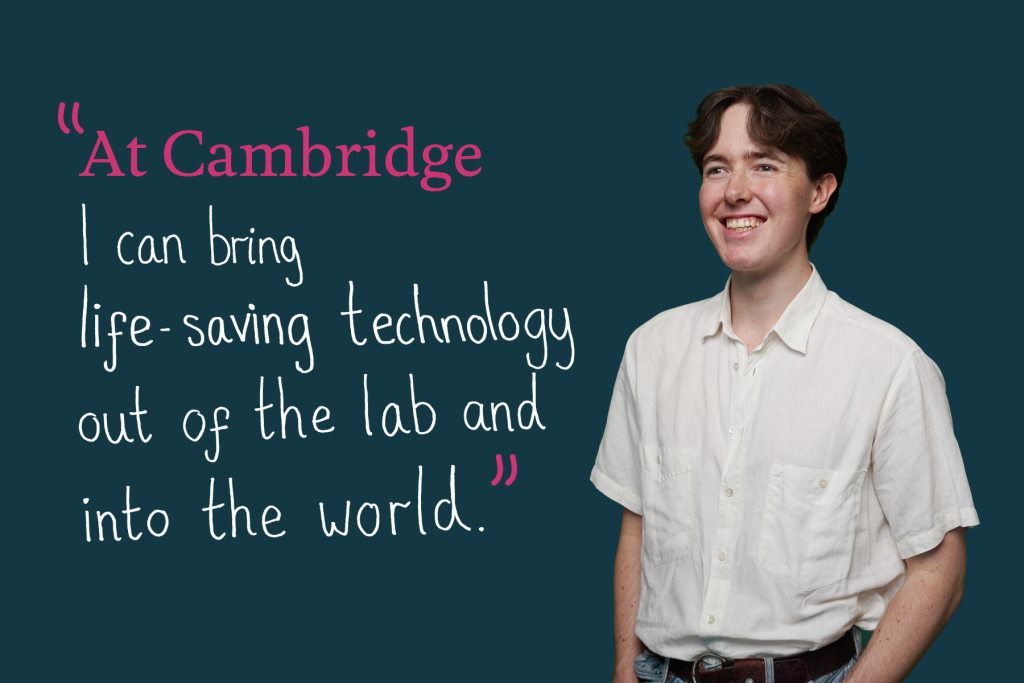
“At Cambridge, I can bring life-saving technology out of the lab and into the world.”

Callan MacDonald
Callan co-founded Polytecks as an engineering Master’s student at Queens' College. Polytecks is developing new ways to map electrical activity in the heart, brain and muscles, making advanced diagnostics much more accessible.

Growing up in rural Devon, entrepreneurship wasn’t something Callan saw around him. His family included teachers and soldiers rather than business founders and the school he attended faced significant challenges.
However, a passion for science and mathematics led him to the University of Cambridge to study biotechnology.
Today, he is co-founder of Polytecks, a medical technology company developing new ways to map electrical signals in the body and make advanced diagnostics more accessible.
Science as a force for positive change
Callan’s motivation for pursuing science is deeply personal.
Alongside his own educational journey, he saw family members benefit from experimental medical treatments that provided hope during difficult circumstances. Experiences like these transformed science from an academic subject into something much more tangible.
It really solidified why I wanted to work in technology, specifically to improve the world and improve people's quality of life.
That belief continues to drive his work today.
Turning interest into action at Cambridge
Although Callan arrived at Cambridge already interested in entrepreneurship, it was the University’s entrepreneurial culture and support that helped him turn that interest into action.
A key moment came when he met his future co-founder, Ruben, in the Department of Engineering. Listening to a research talk together, the pair found themselves urgently discussing the potential impact of Ruben’s technology and the difference it could make for healthcare.
“We sat in the back of the room quite giddy discussing all the potential applications,” he recalls. A few months later, they launched Polytecks.
Alongside building the company, Callan immersed himself in Cambridge’s entrepreneurial programmes, including the inaugural Founders at the University of Cambridge SPARK programme with E-Lab, impulse at the Maxwell Centre, Bio-spark and a range of competitions and showcases. These experiences provided practical support, but more importantly, access to a network of founders, mentors and funding.
Cambridge, he believes, recognises that students can excel in academia and entrepreneurship at the same time.
The power of connections
According to Callan, one of Cambridge’s greatest strengths is that is creates opportunities for people to meet, exchange ideas and discover collaborators in unexpected places. For him, serendipity is the ‘engine’ of entrepreneurship.
Programmes matter, but so do the conversations that happen in laboratories, colleges, cafés and events across the University – so his advice to aspiring entrepreneurs is simply to get involved and start talking to people.
I don't think that anyone who has been successful in entrepreneurship has done it completely by themselves.
Those connections helped turn a promising piece of research into a venture with the potential to transform healthcare.
“It’s our ambition to bring hospital-exclusive advanced imaging technologies into primary care and beyond,” he explains. “Imagine being able to go into a GP’s office and localise an arrhythmia there in five minutes. That’s just one example of the many applications our technology could have.”
That possibility is what continues to drive Callan: using science not just to understand the world but to make life-changing technology accessible to the people who need it most.
How Cambridge helped
The King’s Entrepreneurship Prize is one of the largest equity-free university entrepreneurship competitions in the UK, designed to support members of the King’s College community in developing innovative ideas into commercially viable or socially impactful ventures.
The competition combines funding with mentoring, feedback and exposure to experienced entrepreneurs, investors and business leaders. Applicants progress through several stages, beginning with a short business idea submission before developing increasingly detailed proposals.
Callan was one of the finalists that went on to present their ventures at the Lyons Den, a live pitching event where they present to a panel of judges drawn from the King’s Fellowship and alumni community with expertise in entrepreneurship, investment and business development.
Callam was part of the inaugural Founders at the University of Cambridge SPARK programme in partnership with and subsequently delivered by E-Lab at King’s College. SPARK is a high-impact, residential incubator for students, researchers and alumni ready to turn ambitious ideas into funded ventures with strong foundations for growth.
Bio-spark is an educational entrepreneurship programme that provides support for early-stage scientists, including but not limited to those engaged in a PhD or Postdoc. It provides opportunities to sample different company environments and mentorship that may lead to the formation of companies.
Pitch @ Judge is Cambridge Judge Business School’s regular showcase where Accelerate Cambridge ventures and local start‑ups pitch their ideas, share progress, and test their narrative in front of an audience of peers and invited guests, with feedback and judging from Accelerate Cambridge coaches and mentors. Callan was the winner of his Pitch event.
Impulse is a unique entrepreneurship programme created specifically for early-stage tech and life science innovators as they embark on the journey from scientific insight to validated commercial proposition.
The #21toWatch awards are an annual showcase recognizing the most promising early-stage innovators in Cambridge and the East of England, celebrating founders, companies and technologies with strong commercial potential and real-world impact across biotech, deep tech, AI and climate solutions. Callan was a 2026 winner of these awards.
Find out where IE Cambridge can take you
Learn moreMore stories
-
Teja Potocnik
At Cambridge I can be an engineer and a founder

Teja Potocnik
Teja is the founder and CEO of Nanomation, a semiconductor software startup. She completed her PhD in engineering at Lucy Cavendish College and is developing her venture in ideaSpace.
-
Maheera Abdul Ghani
At Cambridge I can be a scientist and a founder

Maheera Abdul Ghani
Maheera is applying her research in ultra-thin semiconductors into a startup. She is co-founder and CEO of Dielectrix and a Forbes under 30. She is a postdoc in the Department of Material Science & Metallurgy and an alumna of Queens' College.
-
Osarenkhoe Ogbeide
At Cambridge I can connect research, community and venture-building

Osarenkhoe Ogbeide
Osarenkhoe is a Royal Society Fellow in engineering at Churchill College. He is developing graphene-based gas sensors that can detect hard-to-measure gases at much lower levels, enabling new safety-monitoring applications.
-
Callon Peate
At Cambridge I can turn an idea into a startup

Callon Peate
Callon is a PhD student at Clare College and co-founder of GreenMixes, which develops carbon-negative cement additives that cut cement use. He is based in Cambridge’s Institute for Manufacturing.
Get started and make your idea a reality with the help of IE Cambridge