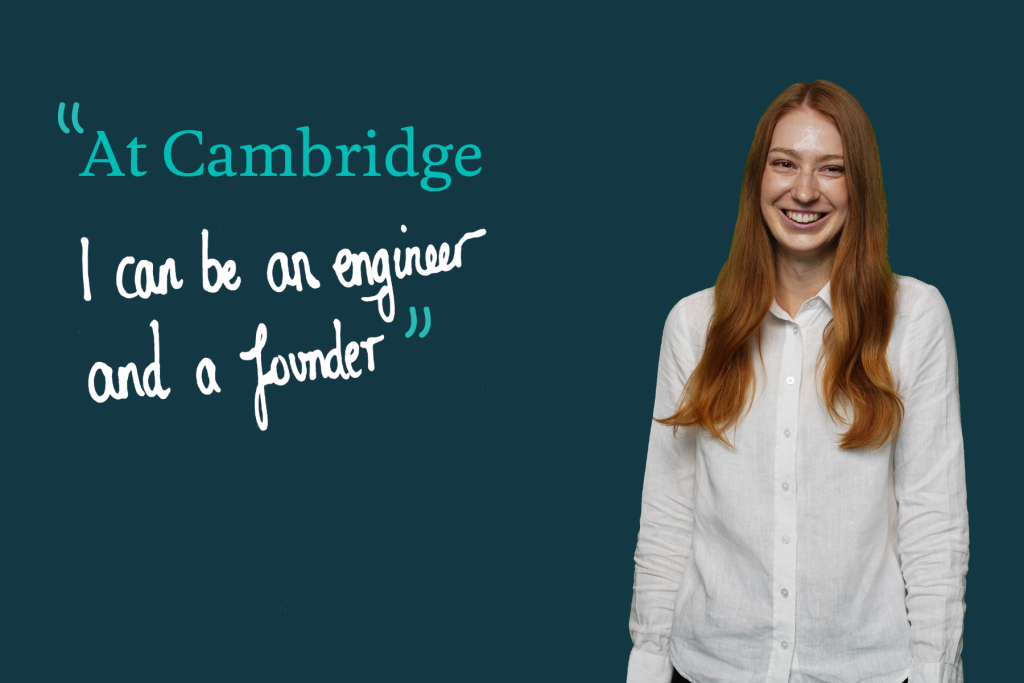
“At Cambridge I can be an engineer and a founder.”

Teja Potocnik
Teja is the founder and CEO of Nanomation, a semiconductor software startup. She completed her PhD in engineering at Lucy Cavendish College and is developing her venture in ideaSpace.

The idea for Nanomation began with a problem that was slowing down Teja Potocnik’s research.
During her PhD in nanoelectronics at Cambridge, she developed a way to automate a slow and repetitive process.
At first, it was simply a practical solution to help her work more efficiently. As she began to recognise the technology’s wider potential, conversations with colleagues and her supervisor encouraged her to think beyond the lab. That combination of technical insight and support gave Teja the confidence to explore what it might mean to be both an engineer and a founder of a startup.
Solving a problem worth fixing
Once Teja realised that the technology could have commercial potential, her next step was to speak with Cambridge Enterprise. The team received support to protect the intellectual property behind the invention and begin exploring how it could be commercialised.
What followed was the creation of Nanomation, which develops nanotechnology-based sensors for industrial and environmental monitoring. Its technology automates the manufacture of advanced materials into electronic devices capable of detecting complex phenomena that conventional sensors may not capture.
The people who supported the original research remained part of the journey. Teja Potocnik’s PhD supervisor encouraged her to pursue the company and is now its Chief Technology Officer, while former colleagues from the laboratory have become important members of the engineering team.
Finding people who help you grow
As the technology developed, so did the support around it.
Teja joined the Founders at the University of Cambridge START programme, where she learned the practical skills needed to build a company, from fundraising and pitching to legal and financial planning.
It was really a full package of information that you need to start a company.
The programme also introduced her to Cambridge’s wider entrepreneurial ecosystem and gave her access to ideaSpace, the University’s startup co-working community.
For Teja, the most valuable part wasn’t just the programmes themselves, but the people behind them. Through mentors, investors, advisors and fellow founders, she built a network that helped her navigate challenges and grow her confidence as a founder.
In ideaSpace she can turn to a fellow founder and ask how they have navigated a particular issue and learn from others that are a little further ahead in their journey.
Confidence comes with practice
Looking back, Teja wishes she had understood earlier that failure is part of the process when founding a startup. Over time, she learned to treat setbacks as data points rather than obstacles.
Every rejection, failed experiment or unexpected result becomes an opportunity to learn and improve. Being surrounded by other founders helped reinforce that perspective. Hearing how others had navigated similar challenges made it easier to keep moving forward because she realised she was not alone.
“Progress comes from a lot of iteration and repeating what you’re doing, rather than from one big Eureka moment,” she says.
Confidence, she believes, does not come before action. It grows through experience.
Take the first step. Test something today if you can and just be brave and confident doing it.
How Cambridge helped
The Wolfson Entrepreneurship Competition is an annual venture competition that brings together students, alumni, investors and entrepreneurs to support the development of promising startups emerging from the Wolfson and Cambridge communities.
i-Teams brings together the brightest students and ground-breaking university research to develop commercially viable strategies and build university-industry links, in Cambridge and beyond.
Cambridge Enterprise is the innovation arm of the University of Cambridge, whose mission is to support the translation of Cambridge research to create globally-leading economic and social impact. From idea development to investment, they provide the diverse support needed by researchers, innovators and talented teams tackling the challenges facing the world today.
Founders at the University of Cambridge is a strategic initiative turning world‑class ideas and research into real‑world ventures delivered by Cambridge Enterprise. START is a pre-seed programme accelerating the next generation of science-led and AI startups connected to the University of Cambridge.
ideaSpace is a co-working space with a strong focus on community with three locations across Cambridge. Each office provides a supportive working environment with great facilities, allowing founders to get on and grow their venture.
Find out where IE Cambridge can take you
Learn moreMore stories
-
Maheera Abdul Ghani
At Cambridge I can be a scientist and a founder

Maheera Abdul Ghani
Maheera is applying her research in ultra-thin semiconductors into a startup. She is co-founder and CEO of Dielectrix and a Forbes under 30. She is a postdoc in the Department of Material Science & Metallurgy and an alumna of Queens' College.
-
Osarenkhoe Ogbeide
At Cambridge I can connect research, community and venture-building

Osarenkhoe Ogbeide
Osarenkhoe is a Royal Society Fellow in engineering at Churchill College. He is developing graphene-based gas sensors that can detect hard-to-measure gases at much lower levels, enabling new safety-monitoring applications.
-
Callan MacDonald
At Cambridge I can bring life-saving technology out of the lab and into the world

Callan MacDonald
Callan co-founded Polytecks as an engineering Master’s student at Queens' College. Polytecks is developing new ways to map electrical activity in the heart, brain and muscles, making advanced diagnostics much more accessible.
-
Micheal Akintunde
At Cambridge I can do my MPhil and build a social venture

Micheal Akintunde
Micheal holds an MPhil in African Studies and is the founder of Bumera, which uses artificial intelligence to help fundraisers build authentic relationships with their donors and raise more money for their causes and communities.
Get started and make your idea a reality with the help of IE Cambridge