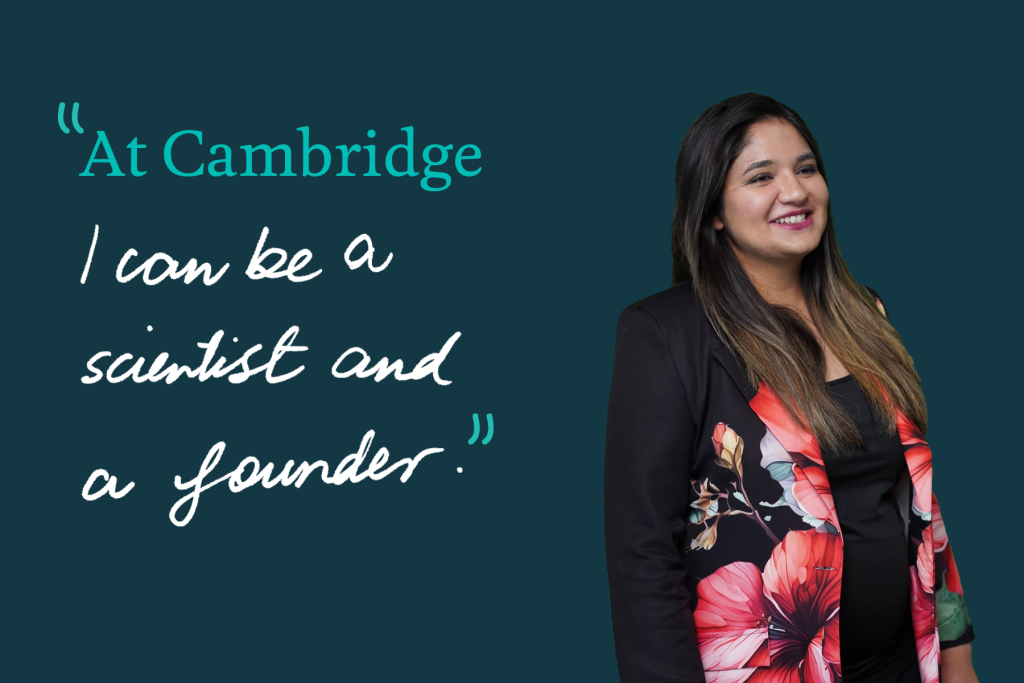
“At Cambridge I can be a scientist and a founder.”

Maheera Abdul Ghani
Maheera is applying her research in ultra-thin semiconductors into a startup. She is co-founder and CEO of Dielectrix and a Forbes under 30. She is a postdoc in the Department of Material Science & Metallurgy and an alumna of Queens' College.

At first glance, research and entrepreneurship can seem very different. When Maheera Abdul Ghani arrived in Cambridge to pursue a PhD in Materials Science and Metallurgy, she certainly thought so. What she discovered, however, was that they had more in common than she first realised.
As a scientist, Maheera became fascinated by the question of how breakthroughs made in the laboratory could create meaningful impact beyond it. That curiosity eventually led her towards entrepreneurship and to co-founding Cambridge Dielectrix, a venture setting out to address a challenge at the heart of next-generation semiconductor hardware: technology to enable smaller, faster and more energy-efficient transistors.
A shift in perspective
One of Maheera’s early introductions to entrepreneurship came through RisingWISE, an award-winning programme for women researchers in STEM from both the Universities of Cambridge and Oxford. For Maheera, it offered a chance to develop entrepreneurial skills and explore how scientific discovery could translate into practical applications.
She also took part in other programmes from across the University, including Impulse at the Maxwell Centre and SPARK at King’s E-Lab. Maheera found herself surrounded by founders, mentors and investors.
I was very fortunate to meet a lot of experienced people and learn a lot from them.
One particular lesson stayed with her: successful ventures do not begin with a solution looking for a problem. Instead, they start by deeply understanding a challenge worth solving.
More similarities than differences
The relationship between science and entrepreneurship may be much closer than many people assume. Both involve uncertainty and persistence. Both begin with questions that do not yet have clear answers.
In our PhD, we lead with a problem where you do not know where it's going to go. I think entrepreneurship is like that.
The difference is that researchers are often trained to seek certainty before acting, while entrepreneurs must learn to take action despite uncertainty. Learning to become comfortable with that uncertainty was one of the biggest adjustments she faced.
It paid off. At the 2025 Postdoc Venture Creation Challenge Grand Finale, Dielectrix took second place and a £10,000 prize from Cambridge Innovation Capital. The judges highlighted its IP-protected technology and high market potential.
Trusting your expertise
Looking back, she wishes she had known that feeling overwhelmed is entirely normal.
Networking did not come naturally and neither did stepping into unfamiliar conversations about investment and commercialisation. As a founder working in highly technical fields such as semiconductors and electronics, there were moments when she questioned whether she belonged in those spaces at all.
Cambridge helped her realise that she did – not because she had all the answers, but because she had spent years developing expertise, curiosity and problem-solving skills that were just as valuable outside the laboratory as they were inside it.
Taking an entrepreneurial mindset forward
Maheera’s entrepreneurial journey has also shown her that becoming a founder does not have to be the only destination. Since exploring venture creation and building Dielectrix, she has moved into a new role in product development and marketing strategy at a global advanced materials company.
It is a role that brings together the different parts of her Cambridge experience: deep scientific expertise alongside a much stronger understanding of products, markets and how innovation moves from the laboratory towards real-world application.
Cambridge expanded Maheera’s sense of what a scientific career could look like. Entrepreneurship was an important part of that journey, giving her new skills and the confidence to move between science, innovation and business. She may have stepped away from being a founder for now, but the entrepreneurial mindset she developed at Cambridge is something she takes with her.
How Cambridge helped
RisingWISE is an award-winning joint programme for women researchers in STEMM delivered by Cambridge and Oxford universities, to provide enterprising early-career researchers with the confidence and skills they need to build their careers across academia, industry or entrepreneurship.
i-Teams brings together the brightest students and ground-breaking university research to develop commercially viable strategies and build university-industry links, in Cambridge and beyond.
EnterpriseTECH at Judge Business School is a transformative 10-week programme tailored for researchers looking to grow their understanding of entrepreneurship and the processes, theory and practice of taking early-stage tech to market.
Impulse is a unique entrepreneurship programme created specifically for early-stage tech and life science innovators as they embark on the journey from scientific insight to validated commercial proposition.
Maheera was part of the inaugural Founders at the University of Cambridge SPARK programme in partnership with and subsequently delivered by E-Lab at King’s College. SPARK is a high-impact, residential incubator for students, researchers and alumni ready to turn ambitious ideas into funded ventures with strong foundations for growth.
The Postdoc Venture Creation Challenge (PVCC) is aimed at supporting busy University of Cambridge postdocs interested in taking their first steps into creating a venture from their research. More than a competition the PVCC provides workshops, mentoring and an incredible launchpad for early-stage ideas.
Find out where IE Cambridge can take you
Learn moreMore stories
-
Teja Potocnik
At Cambridge I can be an engineer and a founder

Teja Potocnik
Teja is the founder and CEO of Nanomation, a semiconductor software startup. She completed her PhD in engineering at Lucy Cavendish College and is developing her venture in ideaSpace.
-
Callan MacDonald
At Cambridge I can bring life-saving technology out of the lab and into the world

Callan MacDonald
Callan co-founded Polytecks as an engineering Master’s student at Queens' College. Polytecks is developing new ways to map electrical activity in the heart, brain and muscles, making advanced diagnostics much more accessible.
-
Dushanth Seevaratnam
At Cambridge I can publish papers and launch a venture
Dushanth Seevaratnam
Dushanth is a postdoc and co-founder of GreenMixes, a startup that develops carbon-negative cement additives that cut cement use. He is at Cambridge’s Institute for Manufacturing and a Bye-Fellow at Churchill College.
-
Sophia Rahman
At Cambridge I can shape the world, not just study it

Sophia Rahman
Sophia is the CEO and co-founder of Studia, which she developed as a Master’s student in Chinese at Lucy Cavendish College. Studia is a creator-led platform that helps educators scale their teaching and offers students affordable, personalised learning.
Get started and make your idea a reality with the help of IE Cambridge