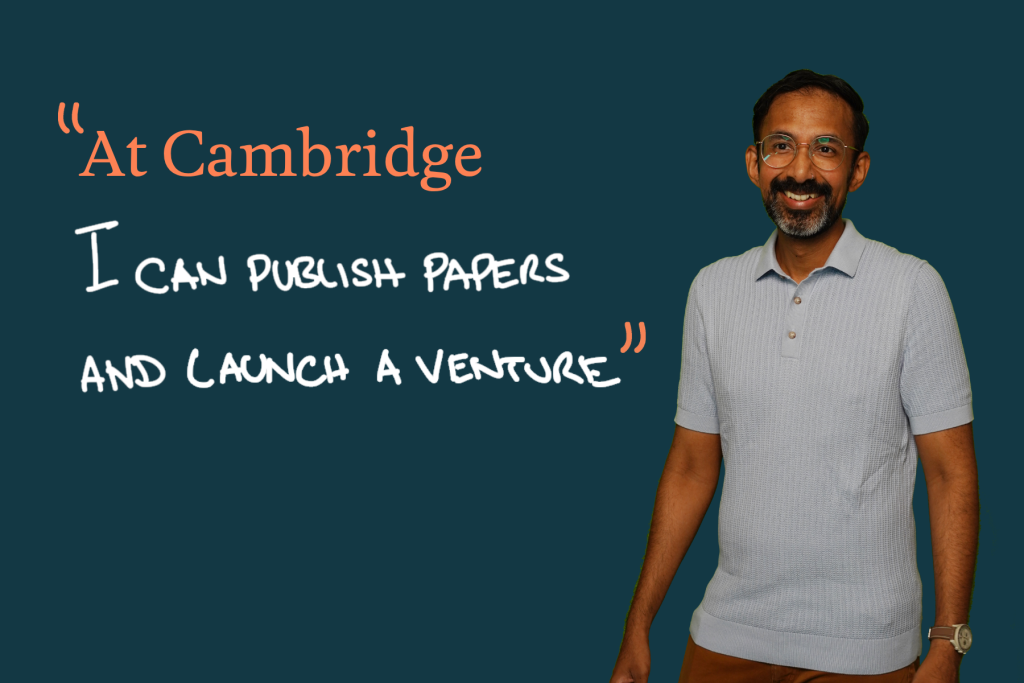
“At Cambridge I can publish papers and launch a venture.”

Dushanth Seevaratnam
Dushanth is a postdoc and co-founder of GreenMixes, a startup that develops carbon-negative cement additives that cut cement use. He is at Cambridge’s Institute for Manufacturing and a Bye-Fellow at Churchill College.

Research and entrepreneurship are not competing paths for Dushanth Seevaratnam. One helps him understand how the world works; the other helps him change it.
As a postdoctoral researcher at Cambridge, he explores the science behind new ideas while also considering what happens next: how discoveries become products that people can use. Alongside publishing research, he is co-founder of GreenMixes, a climate-tech startup developing a low-carbon additive for one of the world’s most widely used materials: cement.
From papers to products
Originally from a Sri Lankan family that was displaced by conflict and raised in Canada, Dushanth came to Cambridge looking for an opportunity to work on projects that could make a meaningful difference in people’s lives. His entrepreneurial journey grew naturally from his research.
Publishing papers remained important, but Dushanth also wanted to understand how new discoveries could move beyond the laboratory and into everyday use.
Entrepreneurship is a much more direct approach of trying to get products into the hands of people who truly need them and can benefit from them.
Not the first idea or even the second
GreenMixes began after conversations with colleagues and future co-founder Callon Peate about the environmental impact of cement. Together, they saw an opportunity to tackle the global challenge of reducing CO₂ emissions in the construction industry, using their scientific expertise.
The solution they are developing today, however, was far from their first idea.
Their initial approach relied on algae. It worked, but it was too expensive. Next came bacteria. Again, promising, but still not commercially viable. Only after several iterations did they arrive at their current chemical synthesis approach, which has the potential to compete with conventional cement production costs.
That process taught Dushanth one of entrepreneurship’s most important lessons: innovation is rarely a straight line.
Leaving the world better than you found it
One of the things Dushanth enjoys most about entrepreneurship is the freedom to apply knowledge in unexpected ways.
Although his background is in biomedical engineering and diagnostics, entrepreneurship has allowed him to apply similar scientific principles to tackle challenges in construction and decarbonisation.
Cambridge played an important role in that journey. He credits programmes such as the Postdoc Venture Creation Challenge with helping GreenMixes move from an idea to a venture, while also providing the confidence and skills needed to navigate the business side of innovation.
His advice to aspiring entrepreneurs is to tap into the people and opportunities around you.
“There will always be someone out there that’s willing to help,” he says.
What continues to drive him is the desire to make the most of the opportunities he has been given and use them to help others.
What gets me up every day in pursuing this dual life is to simply leave the world a better place than when I first found it.
How Cambridge helped
EnterpriseTECH at Judge Business School is a transformative 10-week programme tailored for researchers looking to grow their understanding of entrepreneurship and the processes, theory and practice of taking early-stage tech to market.
The Postdoc Venture Creation Challenge (PVCC) is aimed at supporting busy University of Cambridge postdocs interested in taking their first steps into creating a venture from their research. More than a competition the PVCC provides workshops, mentoring and an incredible launchpad for early-stage ideas.
The Trinity Bradfield Prize aims to encourage and assist young scientists, engineers and entrepreneurs at the University of Cambridge to start companies capable of translating their ideas, inventions and discoveries into products.
The Cambridge Climate Challenge is an annual competition delivered by Cambridge Zero, in partnership with Carbon13, Cambridge Enterprise, the Maxwell Centre, Energy IRC, King’s Entrepreneurship Lab and CISL Canopy. Designed to inspire innovation across disciplines, it invites students, researchers and emerging entrepreneurs to develop bold approaches to reducing emissions, building resilience and driving sustainable change.
The Canopy is a community of impact‑led startups, entrepreneurs, and small businesses accelerating solutions to global sustainability challenges. Part of the University of Cambridge Institute for Sustainability Leadership (CISL), it provides workspace, support and access to networks to help members collaborate, connect and grow. The community brings together founders, academics, corporates and investors to support innovation and partnership.
Co-Labs by Journey provides flexible, fully fitted laboratory and office space for early‑stage science and technology companies in Cambridge. Co‑Labs is particularly suited to collaboration‑driven businesses, with a programme of events and networking opportunities that connect founders with investors, advisors and innovation partners across Cambridge.
Find out where IE Cambridge can take you
Learn moreMore stories
-
Callon Peate
At Cambridge I can turn an idea into a startup

Callon Peate
Callon is a PhD student at Clare College and co-founder of GreenMixes, which develops carbon-negative cement additives that cut cement use. He is based in Cambridge’s Institute for Manufacturing.
-
Osarenkhoe Ogbeide
At Cambridge I can connect research, community and venture-building

Osarenkhoe Ogbeide
Osarenkhoe is a Royal Society Fellow in engineering at Churchill College. He is developing graphene-based gas sensors that can detect hard-to-measure gases at much lower levels, enabling new safety-monitoring applications.
-
Maheera Abdul Ghani
At Cambridge I can be a scientist and a founder

Maheera Abdul Ghani
Maheera is applying her research in ultra-thin semiconductors into a startup. She is co-founder and CEO of Dielectrix and a Forbes under 30. She is a postdoc in the Department of Material Science & Metallurgy and an alumna of Queens' College.
-
Eleanor Bird
At Cambridge I can start again

Eleanor Bird
Eleanor is the COO and co-founder of Studia, a platform that helps educators scale their teaching and offers students affordable, personalised learning. Inspired by her experience of education challenges, she developed Studia as a Master’s student in law at Lucy Cavendish College.
Get started and make your idea a reality with the help of IE Cambridge