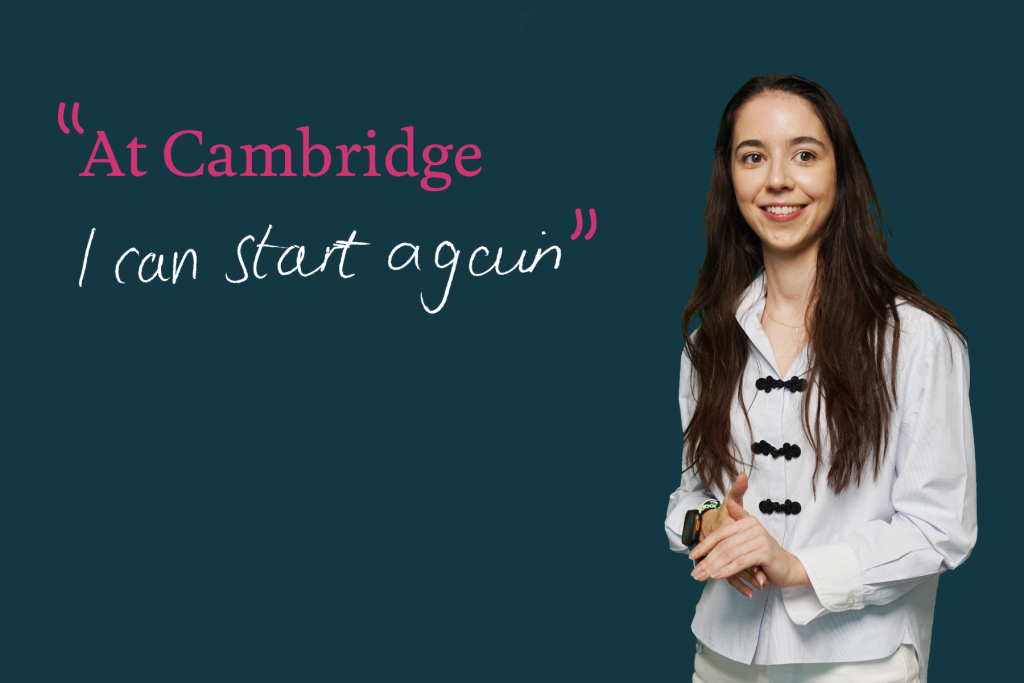
“At Cambridge I can start again.”

Eleanor Bird
Eleanor is the COO and co-founder of Studia, a platform that helps educators scale their teaching and offers students affordable, personalised learning. Inspired by her experience of education challenges, she developed Studia as a Master’s student in law at Lucy Cavendish College.

For much of her early education, Eleanor Bird did not think she was destined for academic success. She struggled at school and often felt left behind. Looking back, she is clear about the intervention that changed the course of her life: tutoring.
Tutoring rebuilt her confidence and transformed her academic performance; she became the first in her family to go to university and completed her master’s in law at Lucy Cavendish College.
For Eleanor, Cambridge felt like a chance to start again. It also brought into focus a question that would shape her future: how could more young people access the kind of personalised learning that had changed her life?
A challenge that changed everything
The answer began to take shape through the Lucy Enterprise Challenge, where Eleanor met fellow student Sophia Rahman, who would become her co-founder and best friend. The annual competition brings together student teams to develop enterprising solutions to real-world challenges, with mentoring and the opportunity to pitch for grant funding.
The Challenge gave her and Sophia the opportunity to test their idea, combine their different strengths and stop treating entrepreneurship as something for the distant future.
Cambridge is where our company Studia was born. The entrepreneurship competition gave us a reason to stop planning and just go for it.
Making great teaching available at scale
Together, Eleanor and Sophia founded Studia, a creator platform for education where educators can build audiences and teach globally. Eleanor describes it simply as “like Twitch, but for tutoring”. Instead of being limited to one-to-one lessons, educators can teach many students at once, opening access to high-quality teaching while creating new ways for tutors to earn.
The venture is rooted in Eleanor’s own experience. She knows what it feels like when the right teaching unlocks confidence and possibility, but she also knows that individual tutoring can be expensive and out of reach for many families. Studia’s ambition is to make brilliant teaching accessible to more learners, at scale.
Letting go of perfect
Building the company has required Eleanor to rethink some of the habits that had helped her succeed academically. Research and study often reward precision and certainty; starting a venture demands action before every answer is known.
Academia rewards perfectionism. Entrepreneurship is the inversion: you ship at 60 per cent.
For Eleanor, that has meant becoming more comfortable with ideas failing, changing direction and listening closely to what the market is saying. Studia emerged from two years of experimentation, including approaches that did not work. Rather than seeing those moments as setbacks, Eleanor sees them as an essential part of building their venture.
They have now built a ‘rockstar team’, plus an army of tutors from Cambridge and Oxford. They are currently raising their seed round and are backed by hugely reputable Silicon Valley investors.
The people who change your path
What Eleanor values most about Cambridge is not simply its reputation or resources, but the people it brings together.
It's a hub of curious people who want to take on big problems.
Through Lucy Enterprise, the social ventures incubator and Cambridge’s wider entrepreneurial community, she found people willing to challenge her thinking and encourage her to act. Her advice to others is to make active use of that ecosystem: join societies, attend events, speak to founders and approach the people whose work interests you.
“You become what you’re surrounded by,” she says. “Be bold. Go and speak to them afterwards.”
She also encourages everyone to look at how things are normally done and ask why not better? It could be the start of something life-changing!
How Cambridge helped
The Lucy Enterprise Programme at Lucy Cavendish College fosters innovation and empowers individuals to make a tangible difference in the world. While designed to cultivate the entrepreneurial spirit within their students, the programme’s impact extends beyond the College, contributing to solutions for global challenges.
The Lucy Enterprise Challenge is an annual entrepreneurship and innovation competition at Lucy Cavendish College that brings together multidisciplinary student teams to develop solutions to real-world challenges aligned with the United Nations Sustainable Development Goals (UN SDGs). Participants receive expert guidance from a dedicated mentor team and pitch their innovative ideas for the opportunity to win a grant prize.
The Cambridge Social Ventures Incubator is a 6–12 month programme supporting early-stage social ventures to start, grow and scale their impact. Delivered by the Cambridge Centre for Social Innovation at Cambridge Judge Business School, the incubator provides tailored support for ventures combining a strong social mission with a sustainable business model. It works with a wide range of ventures, from early-stage ideas to organisations preparing for growth.
Find out where IE Cambridge can take you
Learn moreMore stories
-
Sophia Rahman
At Cambridge I can shape the world, not just study it

Sophia Rahman
Sophia is the CEO and co-founder of Studia, which she developed as a Master’s student in Chinese at Lucy Cavendish College. Studia is a creator-led platform that helps educators scale their teaching and offers students affordable, personalised learning.
-
Micheal Akintunde
At Cambridge I can do my MPhil and build a social venture

Micheal Akintunde
Micheal holds an MPhil in African Studies and is the founder of Bumera, which uses artificial intelligence to help fundraisers build authentic relationships with their donors and raise more money for their causes and communities.
-
Hanniya Kamran
At Cambridge I can design buildings and design a business

Hanniya Kamran
Hanniya is the co-founder of Go Tiffin, a food-sharing startup connecting home cooks with local eaters and Canopy, a social venture linking faith-based charitable giving to climate action. She is an architecture postgrad at Murray Edwards College.
-
Milena Flankova
At Cambridge I can bring my expertise into a new field

Milena Flankova
Milena is a PhD student at Pembroke researching epigenetics in chronic liver disease. She co-founded Nereus Health at Cambridge’s Early Cancer Institute, a rapid diagnostic tests startup, to assess fish population health and detect disease early.
Get started and make your idea a reality with the help of IE Cambridge