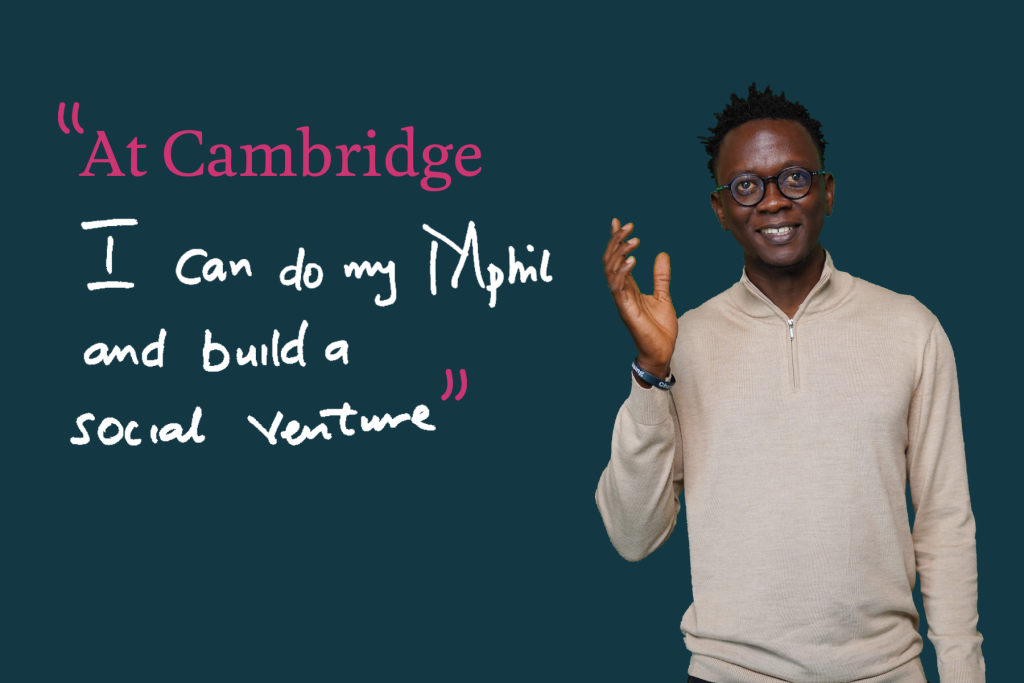
“At Cambridge I can do my MPhil and build a social venture.”

Micheal Akintunde
Micheal holds an MPhil in African Studies and is the founder of Bumera, which uses artificial intelligence to help fundraisers build authentic relationships with their donors and raise more money for their causes and communities

Entrepreneurship means thinking differently, thinking creatively and solving problems that matter to people.
For Micheal Akintunde, that belief has shaped his entire Cambridge experience. Rather than pursuing entrepreneurship for its own sake, he has focused on finding practical ways to help people and communities overcome real-world challenges.
As a Mastercard Foundation Scholar studying for an MPhil in African Studies at Wolfson College, Micheal arrived in Cambridge with a strong interest in social impact. What he did not expect was that the University’s entrepreneurial community would encourage him to see himself as someone capable of building solutions.
The potential to help
Through the Wolfson Entrepreneurship Society, King’s E-Lab and i-Teams, Micheal found himself surrounded by people constantly looking for new ways to tackle social challenges.
I met amazing people that are consistently thinking about coming up with ideas to solve social problems. I thought to myself, why not me?
That question led to his venture, Bumera, which uses artificial intelligence to help early-career fundraisers build meaningful and authentic relationships with their donors. The aim is to help fundraisers raise more money for the causes and communities they serve.
The idea emerged after Micheal began working in fundraising and recognised opportunities to apply his long-standing interest in AI to the challenges he was seeing first-hand.
Ideas are only the beginning
As his entrepreneurial journey progressed, one lesson came up repeatedly: an idea only becomes valuable when it’s tested and refined.
The programmes he joined helped him understand how to identify problems, speak to potential users and evaluate whether a solution genuinely met their needs. Through i-Teams in particular, he learned how to explore different markets and understand customers more deeply.
In Micheal’s view, one of the biggest risks in entrepreneurship is keeping an idea to yourself for too long.
“Your idea could get stuck in your head,” he says. The only way to know whether it is worth pursuing is to put it in front of customers and listen to their feedback.
The people who help you grow
For Micheal, one of Cambridge’s greatest strengths is that support can be found almost everywhere.
Mentors, academics, entrepreneurs and fellow students have all helped him refine his thinking. Sometimes that happened through formal programmes. Sometimes it happened over coffee, in college or through conversations with people willing to share their experience.
Looking back, those interactions taught him something important. Entrepreneurship involves paying attention to the problems around you, being willing to think differently and staying open to what other people can teach you.
Before coming to Cambridge, Micheal saw entrepreneurship as something other people did. Then he met students, researchers and founders who were tackling challenges they cared about and realised there was nothing stopping him from doing the same.
How Cambridge helped
The Mastercard Foundation Scholars Program enables outstanding African students to undertake a master’s degree and grow their leadership skills at one of the world’s top universities. Much more than a scholarship, the programme helps young people fulfil their academic potential and lays the foundations for a meaningful, fulfilling career.
The Wolfson Entrepreneurship Society (WES) is a global network of students, alumni, members and Fellows, which explores and encourages the many facets of entrepreneurship.
i-Teams brings together the brightest students and ground-breaking university research to develop commercially viable strategies and build university-industry links, in Cambridge and beyond.
The Wolfson Entrepreneurship Competition is an annual venture competition that brings together students, alumni, investors and entrepreneurs to support the development of promising startups emerging from the Wolfson and Cambridge communities.
E-Lab, is an initiative of King’s College Cambridge, that aims to foster innovation and cultivate a community of entrepreneurial minds at the heart of the University of Cambridge.
The Cambridge Social Ventures Incubator is a 6–12 month programme supporting early-stage social ventures to start, grow and scale their impact. Delivered by the Cambridge Centre for Social Innovation at Cambridge Judge Business School, the incubator provides tailored support for ventures combining a strong social mission with a sustainable business model. It works with a wide range of ventures, from early-stage ideas to organisations preparing for growth.
Find out where IE Cambridge can take you
Learn moreMore stories
-
Sophia Rahman
At Cambridge I can shape the world, not just study it

Sophia Rahman
Sophia is the CEO and co-founder of Studia, which she developed as a Master’s student in Chinese at Lucy Cavendish College. Studia is a creator-led platform that helps educators scale their teaching and offers students affordable, personalised learning.
-
Eleanor Bird
At Cambridge I can start again

Eleanor Bird
Eleanor is the COO and co-founder of Studia, a platform that helps educators scale their teaching and offers students affordable, personalised learning. Inspired by her experience of education challenges, she developed Studia as a Master’s student in law at Lucy Cavendish College.
-
Ningfei Yuan
At Cambridge I can test startup ideas

Ningfei Yuan
Ningfei is a Classics student at King’s College and works on MNRVA, an art-tech startup developing AI tools for art galleries and collectors. She is developing the business while completing her undergrad degree.
-
Callan MacDonald
At Cambridge I can bring life-saving technology out of the lab and into the world

Callan MacDonald
Callan co-founded Polytecks as an engineering Master’s student at Queens' College. Polytecks is developing new ways to map electrical activity in the heart, brain and muscles, making advanced diagnostics much more accessible.
Get started and make your idea a reality with the help of IE Cambridge