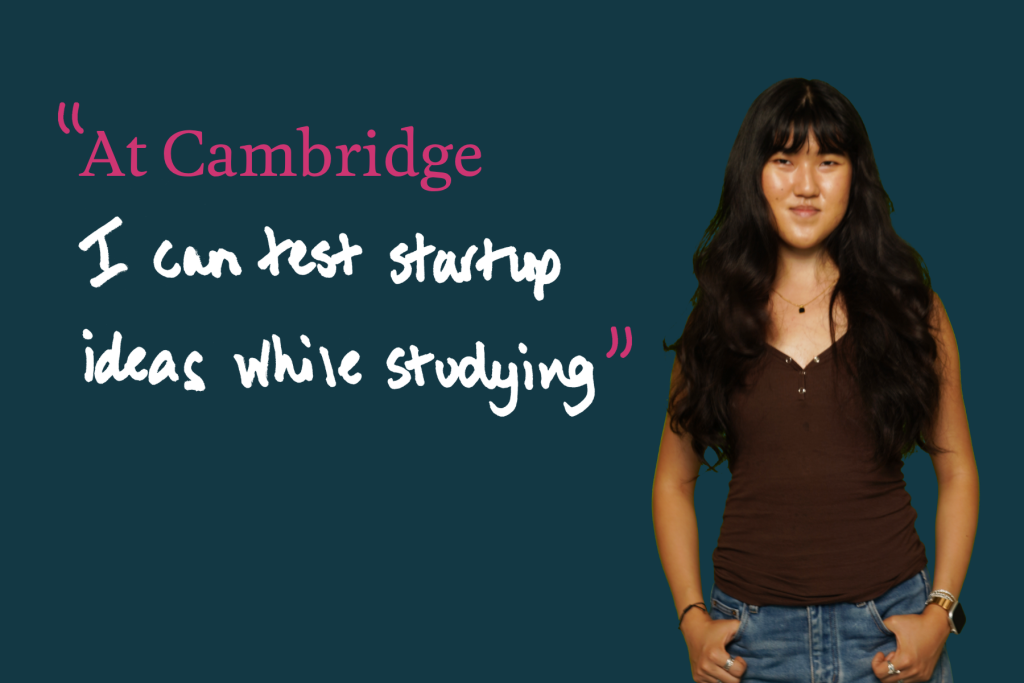
“At Cambridge I can test startup ideas.”

Ningfei Yuan
Ningfei is a Classics student at King’s College and works on MNRVA, an art-tech startup developing AI tools for art galleries and collectors. She is developing the business while completing her undergrad degree.

Entrepreneurship isn’t something that most people would associate with studying Classics.
For Ningfei Yuan, however, it was part of what drew her to apply to King’s College in the first place. During an exploratory visit, she noticed advertisements for entrepreneurial programmes and saw an opportunity to continue exploring an interest she had developed before university. What followed was not a rush to launch a company, but a journey of discovery.
Unexpected connections
Entrepreneurship is often associated with laboratories, technology and technical disciplines, but Ningfei’s experience has shown her another picture.
As a Classics undergraduate, she has found that some of the most exciting ideas emerge when people with different backgrounds come together. One of the things she values most about Cambridge is its ability to bring specialists from multiple fields into conversation.
I think that's something Cambridge does really, really well. It facilitates that kind of interdisciplinary or transdisciplinary way of thinking.
That perspective has influenced her work at MENRVA, a venture that sits at the intersection of technology and the creative sector. By capturing real-time visitor interest and delivering audience insights, it helps galleries and art events better understand and engage their audiences.
It is a reminder that innovation is not confined to any one discipline and that new ideas often emerge at the intersection of fields.
Challenging assumptions
A turning point came through King’s E-Lab, where Ningfei met founders from a wide range of disciplines and backgrounds.
The experience challenged many of her assumptions about entrepreneurship. There was no single template to follow and no typical founder profile. Instead, she encountered people with different motivations, experiences and ambitions, each pursuing their own path.
For Ningfei, that was incredibly freeing. It reinforced the idea that entrepreneurship is not about fitting a mould. It is about remaining curious, learning from others and being open to unexpected opportunities.
The value of a conversation
Looking back, Ningfei wishes she had started more conversations sooner.
When she first arrived at Cambridge, she was hesitant to approach people outside her college, discipline or peer group. Over time, she realised that some of the most rewarding opportunities came from speaking to people she would never otherwise have met.
Whether through entrepreneurship programmes, collaborations across the University or chance introductions, those conversations expanded her thinking and introduced her to new perspectives.
Everyone has a story worth telling.
For Ningfei, that may be Cambridge’s greatest strength: the way it brings different people together. Every conversation offers the chance to gain a new perspective or stumble across an idea that would never have emerged alone.
She also believes students should resist the pressure to have everything figured out. University provides a rare opportunity to explore ideas, test assumptions and learn before committing to a particular path.
In Ningfei’s experience, entrepreneurship is being creative, developing new skills, sitting with uncertainty and staying open to where new conversations might lead. After all, some of the most exciting ideas can emerge from talking to someone you never expected to have anything in common with.
How Cambridge helped
E-Lab, is an initiative of King’s College Cambridge, that aims to foster innovation and cultivate a community of entrepreneurial minds at the heart of the University of Cambridge.
Find out where IE Cambridge can take you
Learn moreMore stories
-
Hanniya Kamran
At Cambridge I can design buildings and design a business

Hanniya Kamran
Hanniya is the co-founder of Go Tiffin, a food-sharing startup connecting home cooks with local eaters and Canopy, a social venture linking faith-based charitable giving to climate action. She is an architecture postgrad at Murray Edwards College.
-
Sophia Rahman
At Cambridge I can shape the world, not just study it

Sophia Rahman
Sophia is the CEO and co-founder of Studia, which she developed as a Master’s student in Chinese at Lucy Cavendish College. Studia is a creator-led platform that helps educators scale their teaching and offers students affordable, personalised learning.
-
Eleanor Bird
At Cambridge I can start again

Eleanor Bird
Eleanor is the COO and co-founder of Studia, a platform that helps educators scale their teaching and offers students affordable, personalised learning. Inspired by her experience of education challenges, she developed Studia as a Master’s student in law at Lucy Cavendish College.
-
Teja Potocnik
At Cambridge I can be an engineer and a founder

Teja Potocnik
Teja is the founder and CEO of Nanomation, a semiconductor software startup. She completed her PhD in engineering at Lucy Cavendish College and is developing her venture in ideaSpace.
Get started and make your idea a reality with the help of IE Cambridge