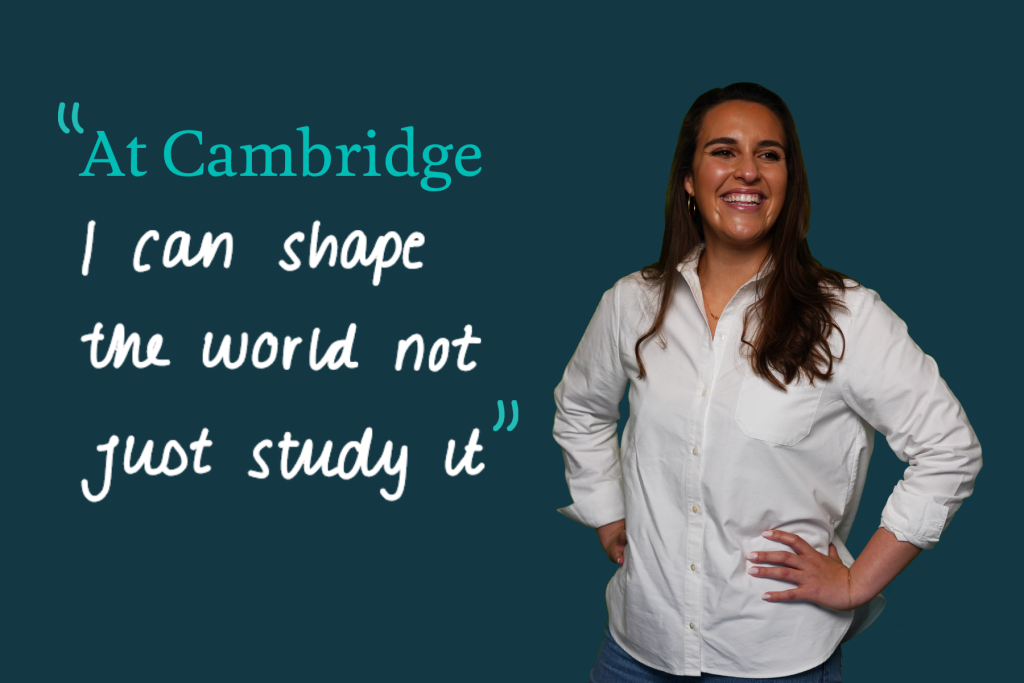
“At Cambridge I can shape the world, not just study it.”

Sophia Rahman
Sophia is the CEO and co-founder of Studia, which she developed as a Master’s student in Chinese at Lucy Cavendish College. Studia is a creator-led platform that helps educators scale their teaching and offers students affordable, personalised learning.

For Sophia Rahman, entrepreneurship began with a simple question. At 17, she found herself inspired by an exceptional teacher and wondered why high-quality teaching wasn’t accessible to more people. That question stayed with her and sparked a passion for making education available to learners everywhere.
In time, that passion would lead her to co-found Studia, an education platform designed to make learning more accessible.
A passion for education
Sophia had been fascinated by Cambridge from a young age. She remembers visiting the city as a child and feeling that it was somehow different. “It just felt magical,” she recalls.
In fact, entrepreneurship was already part of her ambitions before she arrived. Sophia even referenced her dream of founding an education company in her university application. Yet she is clear that having an ambition was only the starting point. It was the opportunities, people and culture she encountered at Cambridge that helped turn that ambition into action.
The moment I set foot on campus, it changed my life. The number of opportunities that it created for us to be able to explore our passions and entrepreneurial endeavours was unbelievable.
Finding a co-founder
One of those opportunities emerged within Sophia’s first few weeks at Lucy Cavendish College, when she entered the Lucy Enterprise Challenge.
Although her team did not win the competition, it proved to be a turning point for a different reason: she met Eleanor Bird, who would go on to become both her co-founder and one of her closest friends.
The pair later joined the Social Ventures Incubator, where they began developing their idea into a real venture. Along the way, they worked with mentors, refined their business model and built the foundations of Studia, a platform that helps teachers grow their audiences while making high-quality education more affordable and accessible for learners.
Looking back, Sophia sees those early experiences as a reminder that some of the most important opportunities at Cambridge can come from unexpected places.
A place to change the world
For Sophia, one of Cambridge’s greatest strengths is its culture of ambition.
I think it's a cultural part of being in Cambridge. The ability to look somebody in the eye and say, 'I'm going to change the world' and for that to be believed and respected.
She credits not only the programmes she participated in, but also the mentors, peers and supporters she encountered along the way. Through the wider entrepreneurial ecosystem, she found people who challenged her thinking, supported her ambitions and helped turn an idea into reality.
Sophia believes Cambridge is a special place for innovators. Her advice is to immerse yourself in the opportunities around you and be open to where they might lead – you never know which conversation, competition or chance encounter might change the course of your life.
How Cambridge helped
The Lucy Enterprise Programme at Lucy Cavendish College fosters innovation and empowers individuals to make a tangible difference in the world. While designed to cultivate the entrepreneurial spirit within their students, the programme’s impact extends beyond the College, contributing to solutions for global challenges.
The Lucy Enterprise Challenge is an annual entrepreneurship and innovation competition at Lucy Cavendish College that brings together multidisciplinary student teams to develop solutions to real-world challenges aligned with the United Nations Sustainable Development Goals (UN SDGs). Participants receive expert guidance from a dedicated mentor team and pitch their innovative ideas for the opportunity to win a grant prize.
Cambridge University Technology and Enterprise Club (CUTEC) is a student‑run society focused on technology‑led entrepreneurship to connect students and researchers with entrepreneurs, investors and industry leaders, helping to bridge academic innovation with real‑world venture creation. Its activities are centred around events, workshops and networking opportunities that provide exposure to commercialisation, fundraising and the wider startup ecosystem.
The Cambridge Social Ventures Incubator is a 6–12 month programme supporting early-stage social ventures to start, grow and scale their impact. Delivered by the Cambridge Centre for Social Innovation at Cambridge Judge Business School, the incubator provides tailored support for ventures combining a strong social mission with a sustainable business model. It works with a wide range of ventures, from early-stage ideas to organisations preparing for growth.
Find out where IE Cambridge can take you
Learn moreMore stories
-
Eleanor Bird
At Cambridge I can start again

Eleanor Bird
Eleanor is the COO and co-founder of Studia, a platform that helps educators scale their teaching and offers students affordable, personalised learning. Inspired by her experience of education challenges, she developed Studia as a Master’s student in law at Lucy Cavendish College.
-
Hanniya Kamran
At Cambridge I can design buildings and design a business

Hanniya Kamran
Hanniya is the co-founder of Go Tiffin, a food-sharing startup connecting home cooks with local eaters, and Canopy, a social venture linking faith-based charitable giving to climate action. She is an architecture postgrad at Murray Edwards College.
-
Ningfei Yuan
At Cambridge I can test startup ideas

Ningfei Yuan
Ningfei is a Classics student at King’s College and works on MNRVA, an art-tech startup developing AI tools for art galleries and collectors. She is developing the business while completing her undergrad degree.
-
Micheal Akintunde
At Cambridge I can do my MPhil and build a social venture

Micheal Akintunde
Micheal holds an MPhil in African Studies and is the founder of Bumera, which uses artificial intelligence to help fundraisers build authentic relationships with their donors and raise more money for their causes and communities.
Get started and make your idea a reality with the help of IE Cambridge